
The fish that time forgot
A fossil fish discovered in a Leeds park has travelled far in time and space

MANY of our cities bask in their modernity. Restless urban machines, they are; ever-changing but somehow a timeless presence in the human mindscape.
Yet each one rests on a bed of deep time against which their history – even that of humanity’s most ancient cities – is but a sliver of a footnote.
A timely reminder was recently found in Leeds, West Yorkshire, when the fossilised remains of a 320-million-year-old fish was unearthed at the city’s Roundhay Park.
Some may be familiar with the park, as a local beauty spot, or as a venue for music festivals, but in the days when this fossil bore flesh and breathed water, the place was a vast tropical lagoon.
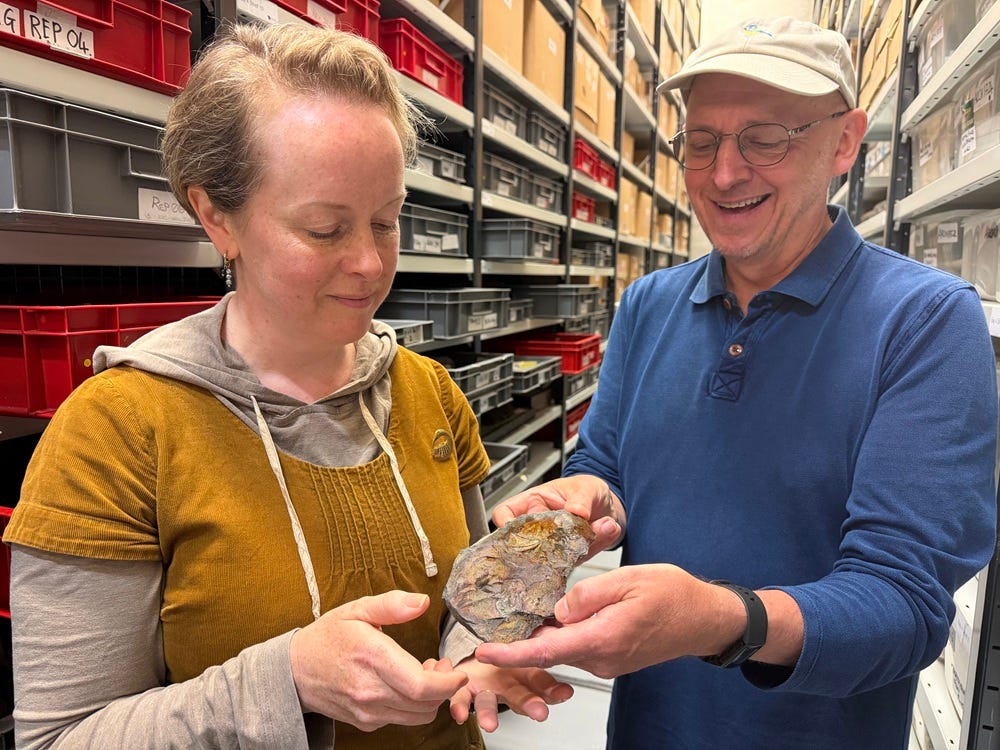
The fossil was found by Ru Smith from the Yorkshire Geological Society. To say the find was unexpected, is a bit of an understatement; he was only conducting a reconnaissance walk ahead of a planned field trip in the park.
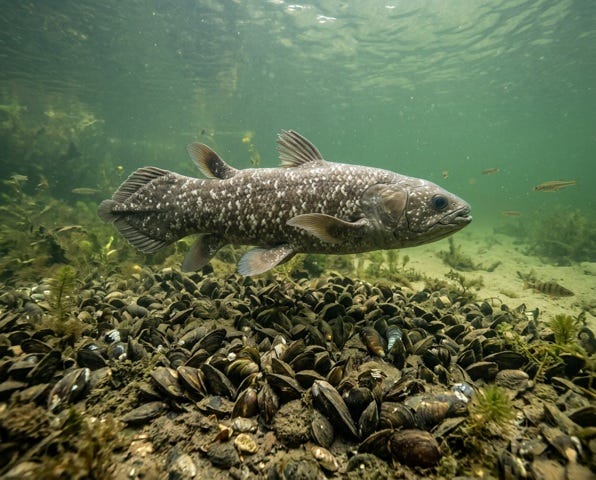
“There’s a layer of rock in the park which dates from around 320 million years ago,” Smith said, “from a time before the breakup of the continents, when what is now the park would have been situated close to the Equator and under the warm waters of a tropical lagoon. West Central Africa would be a good place to find similar environments in the present.
“There’s a bed of freshwater mussels called Carbonicola at one level in the rock, and opening a piece of shale from this bed in my hands I saw something unusual – a distinctive skull bone of a large fish. I knew straight away this was something different and very rare.”
This turned out to be a coelacanth, a rare survivor from such ancient times in more way than one. The species is known as a ‘living fossil’ because – while Smith’s fish is very much extinct as an individual – its kin live on.
Ancient survivor
For many years, scientists believed the coelacanth had died out around the same time as the dinosaurs. Then in 1938 a modern specimen was pulled alive from the sea by local fisherman off the East coast of South Africa. It was subsequently spotted by experts in a fish market.
Smith’s discovery in Roundhay Park was verified by fellow experts as belonging to a coelacanth older than those found elsewhere in Yorkshire, making it the oldest found in the region.
When the fish was fossilised during the Carboniferous period, the Earth was a vastly different place to the one familiar to modern humans. The planet was much warmer and the immense supercontinent of Pangea – essentially all of the continents we know today bunched together into one single landmass – was forming.
While fish such as coelacanths shared the world’s oceans with sharks and now extinct marine invertebrates, the land at the time was ruled by giant insects and early amphibians. There were no dinosaurs; there were no mammals or birds. Humans, of course, were a long, long way from being even a glint in evolution’s eye.
“Coelacanths are pretty amazing fish and it’s just very cool to think that at one time, you could have been standing in Leeds and watching them swim around above a bed of mussels in Roundhay Park,” Smith added.
“That’s really the wonder of geology, looking at the rock and time travelling in the imagination to what was a very different world.”
Good company
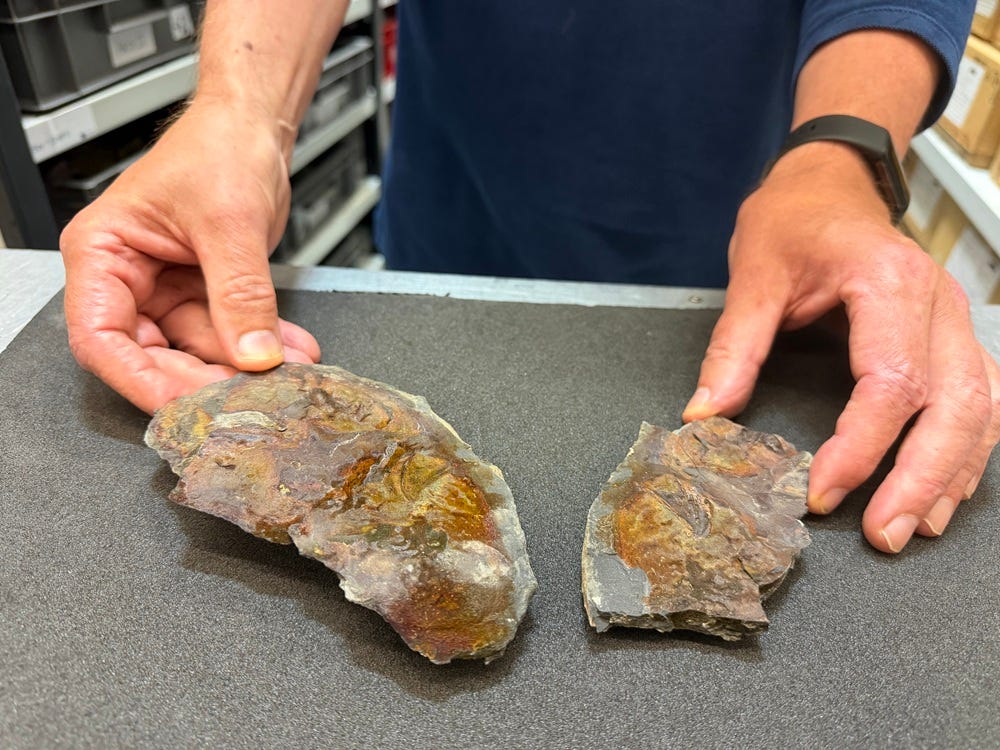
The fossil has now been donated to Leeds Museums & Galleries, where it’s been added to the national sciences collection at Leeds Discovery Centre. The exact location of the find has not been disclosed to protect the parkland, and ensure that any geology field work is only undertaken by professionals.
Smith’s coelacanth is in good company at its new home. It has joined an array of prehistoric aquatic finds, which include the world’s best specimen of the giant Carboniferous megalichthys fish found in 1883 near Leeds, as well as fossilised remains of younger marine reptiles such as dolphin-like ichthyosaurs and long-necked plesiosaurs.
“This is a remarkable find and we’re extremely grateful to Ru for donating his discovery to our collection,” said Clare Brown, curator of natural sciences, Leeds Museums & Galleries.
“Responsible and ethical fossil hunting and geology can yield some incredible results and really help us to build a picture of life in prehistoric Leeds, and the history that’s resting beneath our feet no matter where we may be. We’re always keen to work with local organisations and would encourage anyone interested to join a group.”
Councillor Salma Arif, the city council’s executive member for economy, added: “Extraordinary finds like this really do bring home what a unique place Leeds is and the sheer volume of history that’s all around us across the city.
“We’re very fortunate to have such a fascinating and ever-evolving record of Leeds, spanning hundreds of millions of years and giving our visitors the chance to discover the story of our city.”
MC
Image credit: All photos courtesy of Leeds Museums & Galleries